

Dressed to Repress
What your wardrobe knows about you that your therapist doesn’t ask

Let me start with a confession: I was insufferable. Growing up, I rolled my eyes at my parents’ work in fashion with the obnoxious condescension of someone who had just discovered philosophy and hadn’t yet discovered humility.
Clothing? I was destined for the life of the mind, Plato’s Academy, capital-T Truth, the unencumbered life of Pure Reason. Had I actually made it to the Academy, I would have worn a toga—the original garment of the disembodied thinker. The toga makes the question of what to wear beautifully unnecessary. There are no choices, no vanity, and no embarrassing evidence that you live in a body; just draped fabric and Pure Reason.
I found this aspirationally appealing. It was the adolescent eye roll directed at the very thing that paid for my braces and ballet classes.
My childhood therapist was responding to a child who arrived weekly with the same complaint: they cannot stop talking about hemlines. Not ideas. Not books. Not the interior life of anything. Just surfaces, seams, and what was happening this season. I was as bored as if I’d been forced to sit through the MacNeil/Lehrer NewsHour on a loop. I wanted to talk about something that went deeper than a neckline.
The request was the desperate plea of a child who had not yet understood that the surface and the depth were the same conversation. I was very sure about this at thirteen. Thirteen usually is.
The Problem with Cerulean
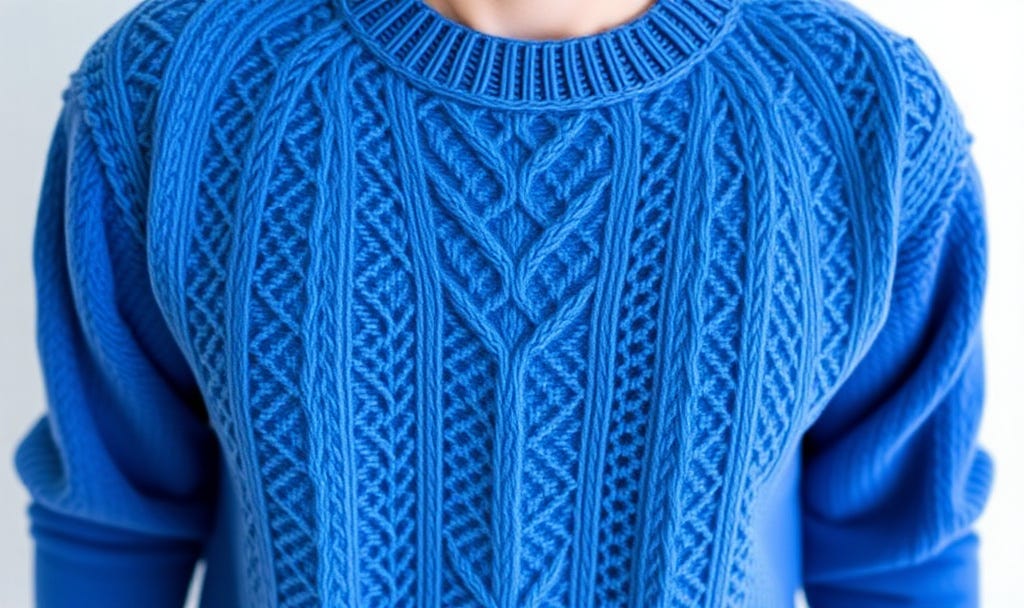
My parents gave me the “Cerulean Blue” lesson long before Miranda Priestly delivered it to the masses in The Devil Wears Prada. I learned how a single color decision made in a high-fashion atelier trickles down, season by season, until it lands in a bargain bin and onto the back of someone who would never know it started there. My eyes were trained, reluctantly, then resentfully, then, against my will, with genuine fascination. I did not want to find it interesting. I wanted to find it beneath me.
The problem was that I also, against my will, loved clothes, but I loved psychology too. At fourteen, I was simultaneously wearing Norma Kamali dresses and reading Jung. A teenager in a Kamali dress with a copy of Memories, Dreams, Reflections is not a person who has chosen between the material and the psychological. She is a person who has already solved the problem and just hasn’t written the essay yet.
The Ghost of Descartes in Your Closet
A strange gap persists between these two worlds. Why you wear what you wear almost never makes it into the therapy room. What it means psychologically almost never makes it into fashion coverage. We treat skin and psyche as if they don’t share the same body.
Psychology ignores clothing. Fashion ignores psychology. And neither seems embarrassed about it.
Therapists will spend fifty minutes on your relationship with your mother and not one minute on why you have worn black every day since the divorce.
Fashion editors will spend ten pages on what is happening with the waist this season and not one sentence on why you care.
Every trend is a document. The shoulder pad is a generation of women suiting up for a fight. The “ugly shoe” is a refusal of the idea that a woman’s foot exists to be looked at rather than to walk somewhere. Vogue could say all of this. It chooses instead to tell you what to wear this spring.

Green Taffeta and Pure Reason
This prejudice is a professional inheritance. Western intellectual culture is haunted by the intellectual ghost of René Descartes. It was a clever line—I think, therefore I am—that created a clear hierarchy: the Mind was the master and the Body was a mechanism.
The hypocrisy, or perhaps unconsciousness, of it all is that the man who demoted the body to a mere machine was actually a dandy. While he was busy severing the soul from the flesh, he was living in Paris wearing “green taffety,” a sword, and a feather in his cap. Historical descriptions even find him coiffed in curls, wearing pointed shoes and snow-white gloves.
Descartes wanted us to believe the mind was the only thing that mattered, yet he took great care to ensure the “machine” carrying that mind was meticulously packaged in a great outfit. He spent his life performing the role of the disembodied thinker while dressed like the seventeenth-century version of a man with an exceptionally good stylist. We have been going along with this for centuries, pretending that the more we care about ideas, the less we should care about what we wear.

The Fig Leaf and the Shopping Bag
I went after this gap in grad school. I spent a year writing my thesis on The Genesis of Shame in the Fig Leaf of Fashion and Its Place in Psychotherapy. My argument was that the first act of human consciousness wasn’t a prayer; it was an outfit. The moment we became aware of our Self, we became aware of our nakedness. The fig leaf was the first boundary, the first bridge between our internal “I” and the external world.
I handed it to my academic advisor. He gave me positive feedback on the scholarship and the novelty of the premise, but it was his parting line that really stung: “This thesis makes me want to go shopping.”
In one sentence, he turned a year of scholarly labor into a trip to a department store. I sat with the dismissal for a long time. And then, eventually, I reconsidered. It’s possible he wasn’t mocking me. It’s possible he was saying that he, a man who had spent his career living entirely above the neck, had been moved, against his better judgment, to go update his own fig leaf. I choose to take it as a compliment now

Freud’s Body, Jung’s Mask
If my advisor had looked past the shopping bag, he might have remembered that the fathers of our field were far more concerned with the surface. Sigmund Freud famously wrote that “the ego is first and foremost a bodily ego.”
Our clothing is a primary site of sublimation. Your closet is the place where your wildest, most chaotic impulses go to get a haircut and a job:
Aggression becomes a sharp, navy blazer.
A need for protection becomes a chunky cashmere sweater.
Sublimation is the magic trick of turning a “scream” into a “look.”
Carl Jung took it even further with the Persona. He didn’t view the “mask” as a lie; he viewed it as a necessity. He knew the soul is too vast to walk around “naked.” We need a Persona to mediate between our internal depths and the external collective. The danger isn’t in having a Persona; it’s in having one that doesn’t fit. When we are forced into a “professional” uniform that feels like a shroud, we aren’t being “neutral.” We are being suffocated.
The Judgment of the Leopard Heels
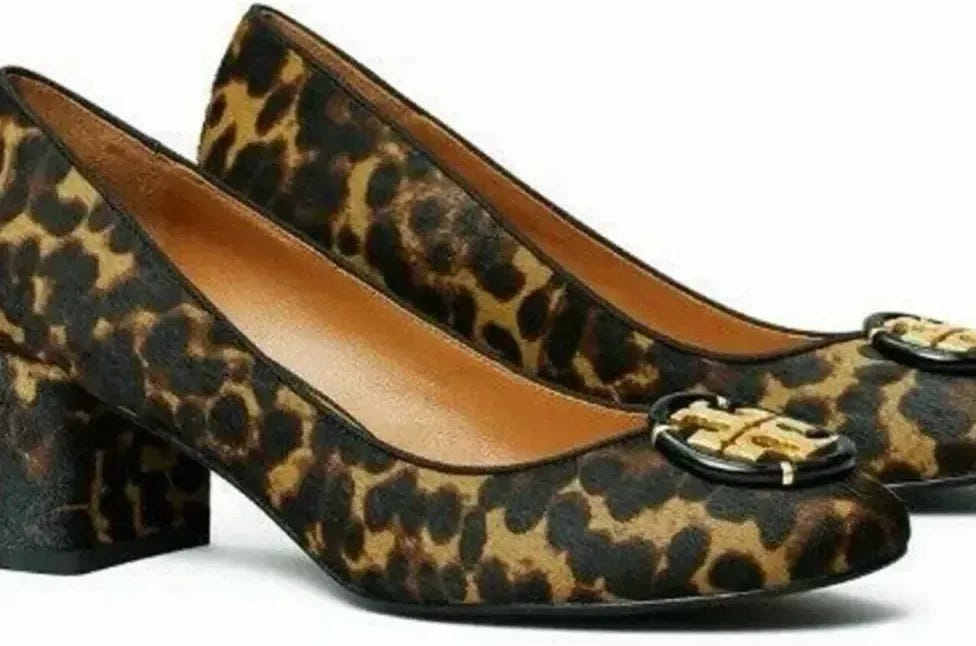
Years later, I was renting office space from a fellow therapist whose own office was a study in deliberate erasure: bare walls, neutral carpet, not a single object that might betray a preference. One day, he looked at my Tory Burch pumps, sensible, block-heeled, leopard print, and called them “distracting.”
He wasn’t just complaining about the noise of my heels; he was implying that leopard print was an unwanted guest in a sanitized clinical hallway. It was the Split in real-time: the idea that for a woman to be a “serious” healer, she must first agree to be invisible.
He didn’t realize that my love for leopard was a psychological statement of my fierceness, my protectiveness, and my connection with the un-shushable parts of the psyche. Looking back, he wasn’t worried about my shoes being distracting to my patients; they were distracting him from himself. He felt something he wasn’t prepared to examine, and it was far easier to police my print than to sit with his own—dare I say—erotic transference.
Even Nakedness is a Persona
The great irony is that the “blank slate” is its own kind of costume. I remember a training program where a candidate asked if she should remove her wedding ring so her patients wouldn’t project feelings about marriage onto her. A wise analyst didn’t miss a beat: “Even nakedness is a persona.”
There is no such thing as an absence of style. The therapist who performs “neutrality” by abdicating aesthetic responsibility is making as loud a statement as the woman in the leopard heels. They are wearing the Persona of the Disembodied Thinker, usually in a sensible cardigan that whimpers “I have repressed my aesthetic needs for the sake of your breakthrough.”
The Toga Was Always an Outfit
We must stop treating the aesthetic as the enemy of the authentic. I finally understand what that thirteen-year-old didn’t: that the toga wasn’t an escape from fashion; it was just another outfit. It was a costume designed to signal depth by performing a specific type of neglect.
Choosing a bone-white linen or a charcoal wool is an act of self-collection. It is the ego saying, “I am here, I am contained, and I am ready to be seen.”
The psyche is in our material choices. It is in the seams, the hemlines, and the textures. If you’re going to venture into the depths of the human psyche, you might as well do it in shoes that prove you’re actually standing on the ground. We aren’t floating minds; we are draped, layered, and beautifully upholstered creatures.
That, finally, is a truth worth wearing.