Myers-Briggs, Astrocharts, and Enneagrams, Oh My: The Quest to Be Known
The radical shift from fixed identity to the art of including your entire, messy story.
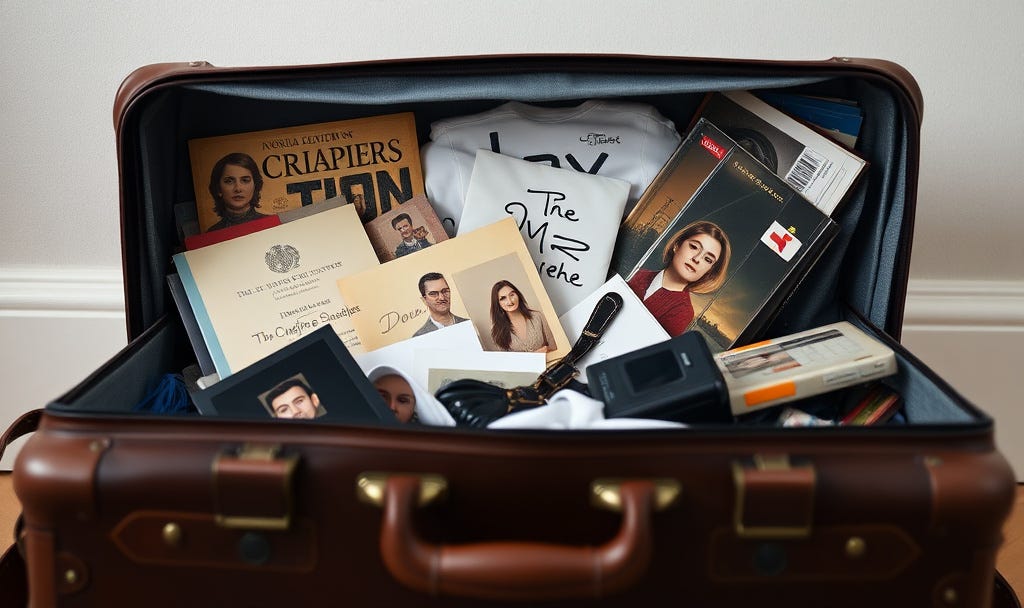
At eight years old, on a family vacation to Honolulu, I arrived at the Hilton Hawaiian Village armed with a floral green suitcase, sunscreen, and a singular, ironclad conviction. My father had recently told me that we had Osage ancestry, and as a child, I didn’t just accept this as part of my heritage; I inhabited it as my entire identity. In every interaction with the concierge, the housekeepers, or strangers in the elevator, I introduced my tribal lineage with a solemn, but ultimately misplaced pride. I don’t know how those strangers responded to a child offering such a bizarrely specific ancestral claim, but at the time, I am not sure I cared.
I didn’t know it then, but that was my first elevator pitch. It was a bid for importance, a signal that I was more than I appeared to be. The irony was obvious to everyone but me. I was an extremely pale, blue-eyed child whose lack of melanin, need for constant sunscreen reapplication, and smattering of Celtic freckles suggested ancestors who had never seen a sun stronger than an Irish mist.
By my teens, I swapped the Osage myth for an Irish one. I rejected my mother’s Austrian legacy entirely because I didn’t want the blood if it meant being tethered to the person I battled with every morning about what I wore, what I ate, and how I did my hair. To accept the ancestry felt like accepting the conflict, so I chose a different identity to cling to.
Growing up in a family that had me seeking Al-Anon at fifteen, I wanted a version of my family that was more romantic than the one I had. I imagined stony cottages and poetic pub owners, clichés that bridged the gap between my lived experience and the gentle Irish version I created for myself. I held that self-concept for decades until an ancestry DNA site told me it was, again, a fiction. A tube of spit and $95 cost me that fantasy too. It turns out I was primarily Scottish, with British, Welsh, Norwegian, and, yes, that Austrian mixed back in.
The Diagnostic Shelter
In my practice, I often see this same “Hilton Hawaiian Village” energy: an introduction of self using shortcuts. My Myers-Briggs is... my Enneagram is... my diagnosis is... We see this trend exploding in modern dating profiles as well. People list a string of acronyms and personality types as if they are ingredients in a recipe for who they really are. It is an attempt to create the illusion of being known before a single real conversation has taken place.
These labels offer a profound sense of relief. For many, a diagnosis or a personality category is the first time their suffering or their quirks are given a name that isn’t “lazy,” “crazy,” or “wrong.” It provides a framework for self-compassion and understanding. This urge to categorize is an ancient human reflex, whether we are balancing “humors” like the ancients or checking boxes in a modern clinical manual. We have always sought systems to name our experience because there is strength in the “we.” To find oneself in a category is to realize you are not uniquely broken, but part of a known human pattern.
During my own dark night of the soul, I collected these labels as a way to make the pain meaningful and, perhaps more importantly, curable. A therapist diagnosed me with Major Depressive Disorder. A naturopath, upon hearing the same symptoms, diagnosed my exhaustion as Chronic Fatigue Syndrome and Candida. An MD said I had Hashimoto’s and hypothyroidism. A test in a book had me scoring positive as a “Highly Sensitive Person.” Suddenly, my discomfort had names and explanations, so I sought more tests and identities that explained me to myself.
The Procrustean Bed
Beyond the world of psychological diagnosis, let us turn to Greek mythology. Meet the Procrustean bed. There was a giant, Procrustes, who would stretch his guests or lop off their limbs to ensure they fit his bed perfectly. We use this “bed” in lots of ways, and none of them are great. The language of identity and diagnosis can be a kind of selective amputation.
If I over-identify as a “Highly Sensitive Person,” I might suppress my own resilience because it does not fit the frame. If I identify as “The Introvert,” I might decline an invitation that my soul actually needs, failing to see that my preference for avoiding parties might actually stem from childhood trauma rather than introversion. Labels can edit out our complexity just so we stay within the lines of whatever identity we currently prize.
James Hillman, the founder of archetypal psychology, who preferred the language of myth to the language of medicine, argued that these diagnoses are essentially fictions. He did not mean the suffering was not real; he meant that a label like “Depression” is a poetic attempt to describe the dark night of the soul. According to Hillman, when we treat a diagnosis as a literal, biological fact, we kill the story. When we see it as a meaningful fiction instead, a character in our internal play, we finally allow it to have a voice.
The Language of Inclusion
There are many ways to use these labels, fictions, or diagnoses. They can be meaningful and an entrée point into deeper self-knowledge, but they can also be a Procrustean bed. I would like to encourage seeing them as parts of us, a way of communicating aspects, but they are never the whole enchilada.
As Walt Whitman famously wrote:
“Do I contradict myself? Very well then, I contradict myself. (I am large, I contain multitudes.)”
The shift from “I am” to “I include” is the mark of psychological maturity. When we say “I am a Type 4” or “I am a Pisces,” we have walked into a trap. When we say “I include,” we no longer have to lop off the parts of ourselves that contradict the label. Changing the language changes the architecture:
Instead of “I am an INFJ,” try: “I include an introverted preference.”
Instead of “I am depressed,” try: “My experience includes a period of depression.”
Instead of “I am Scottish,” try: “I include a complicated genetic ancestry; while I am primarily Scottish, I tend to identify with my Irish roots.”
Beyond the Shorthand
We cannot be boiled down to types, signs, or nationalities. Overidentifying with a label is an oversimplification, a quiet way of saying, “I cannot help it; I am just wired this way.” But these labels, whether medical or mythic, were never meant to be a destination. They were merely way stations we visited while trying to find our way home to ourselves.
The real work of psychological maturity is the realization that we are not the diagnosis, the archetype, or the genetic report. We are the ones experiencing them. By shifting our internal architecture from “I am” to “I include,” we give ourselves permission to be complicated, contradictory, and whole.
We can hold the label without becoming it. We can acknowledge the parts of our story, the struggle, the heritage, the temperament, without letting them eclipse the person who is holding the pen. In the end, we are far too expansive to be contained by a single checkbox or a $95 DNA kit. We are not a suitcase full of labels; we are the traveler who decides what is worth carrying.